Year 6 English Word Work Printable primary worksheets

All of our Year 6 English Word Work resources come complete with answer sheets to save time for busy teachers and parents. Input your child’s scores and keep track of your child's progress.

worksheet plans from £3.20/month
Filters

95 results

Relative clauses

Relative clauses

Relative clauses are used to connect sentences. We use relative clauses to give additional information about something without starting a new sentence. The most common relative pronouns are: who, whom, whose, which and that. This English resource asks students to choose the best relative pronoun to complete the sentences.

Age: 10 - 11
1
2
3
Verb prefixes - de and re

Verb prefixes - de and re

A prefix is a group of letters added before a word to alter its meaning. The prefix 'de' is used to reverse the verb's actions. It can also mean 'down' such as in the words decrease or decline. The prefix 're' means to do again. This English resource asks students to choose the correct word to complete the sentence.

Age: 10 - 11
1
2
3
Verb prefixes - dis and mis

Verb prefixes - dis and mis

A prefix is a group of letters added before a word to alter its meaning. The prefix 'dis' is generally used to make a word negative. The prefix 'mis' means badly, wrongly or incorrectly. This English resource asks students to choose the correct word to complete the sentence.

Age: 10 - 11
1
2
3
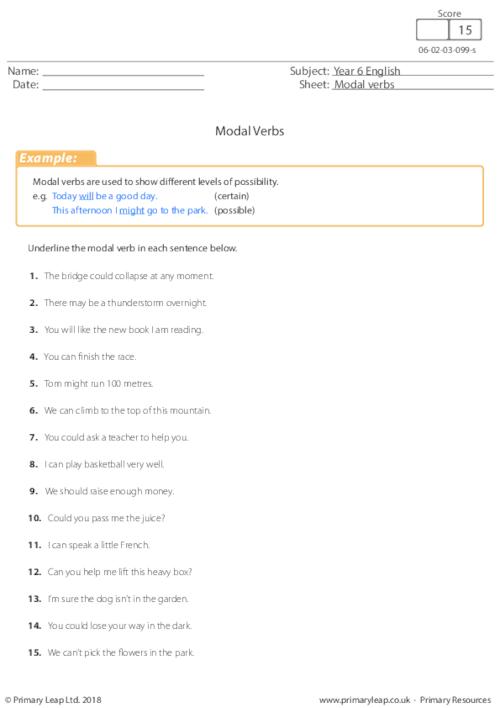
Modal Verbs 2

Modal Verbs 2

A KS2 literacy worksheet on modal verbs.

Age: 10 - 11
1
2
3
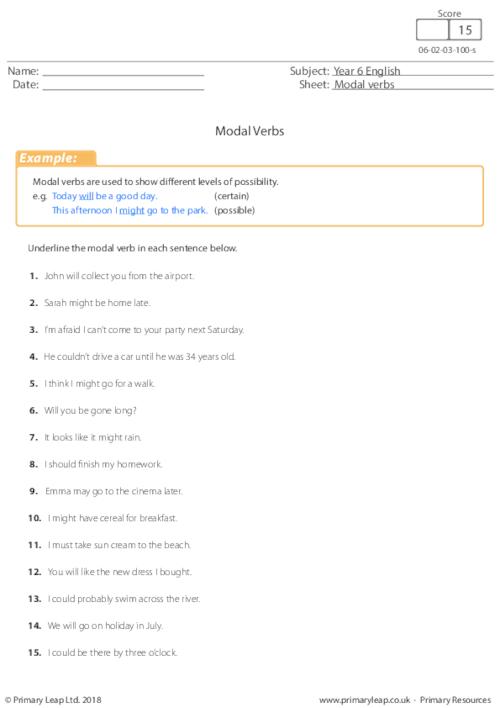
Modal Verbs 1

Modal Verbs 1

This KS2 literacy resource is all about modal verbs.

Age: 10 - 11
1
2
3
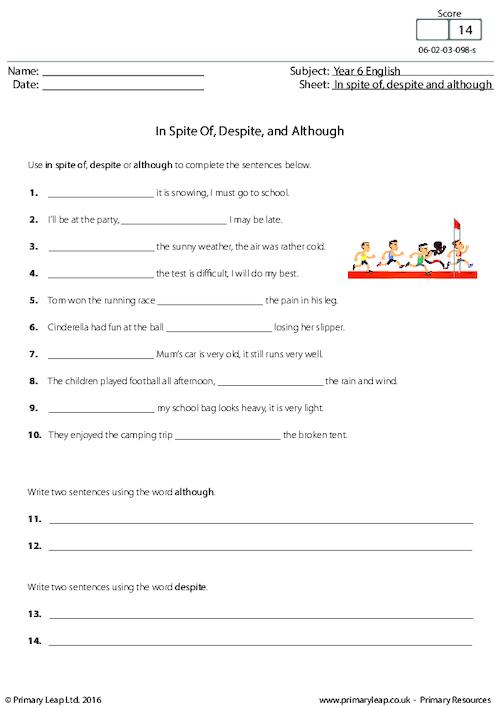
In Spite Of, Despite, and Although

In Spite Of, Despite, and Although

Students must firstly fill in the gaps using the correct word. They are then asked to write sentences using their own ideas with the words given.
Age: 10 - 11
1
2
3
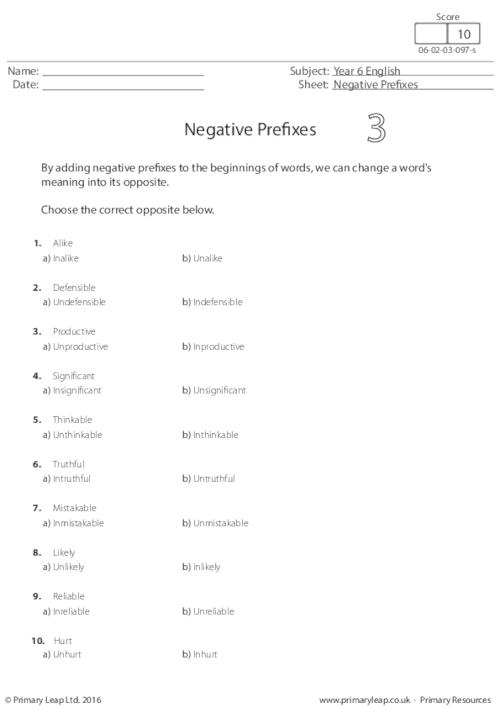
Negative Prefixes 3

Negative Prefixes 3

By adding negative prefixes to the beginnings of words, we can change a word's meaning into its opposite. Students choose the correct opposite.

Age: 10 - 11
1
2
3
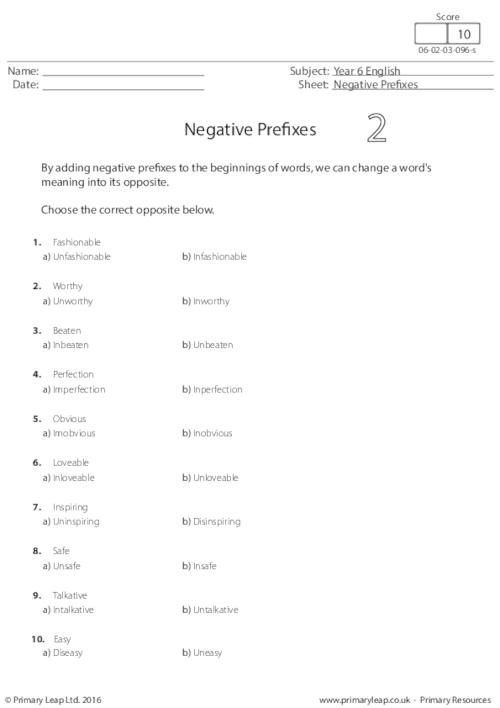
Negative Prefixes 2

Negative Prefixes 2

By adding negative prefixes to the beginnings of words, we can change a word's meaning into its opposite. Students choose the correct opposite.

Age: 10 - 11
1
2
3
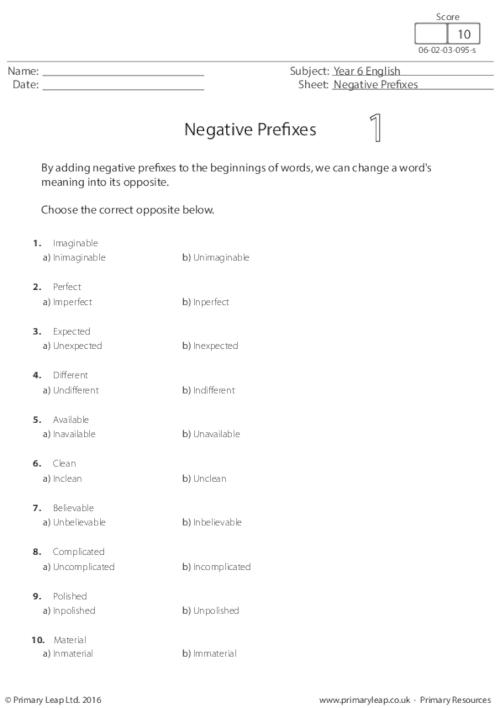
Negative Prefixes 1

Negative Prefixes 1

By adding negative prefixes to the beginnings of words, we can change a word's meaning into its opposite. Students choose the correct opposite.

Age: 10 - 11
1
2
3
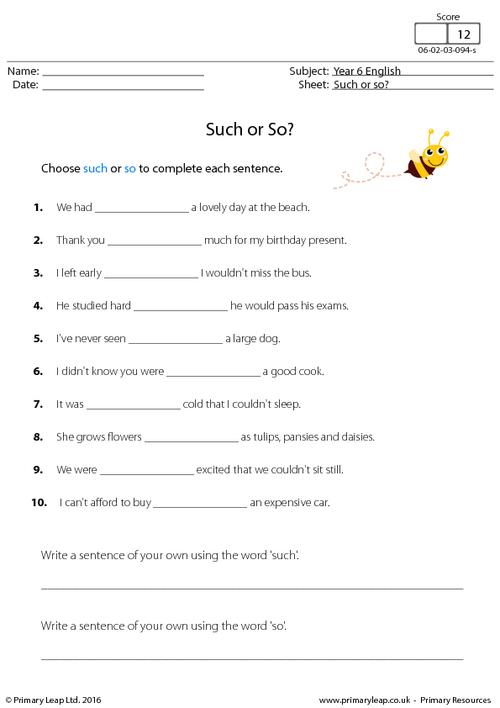
Such or So?
Such or So?

Such or so? Students are asked to choose the correct word to complete each sentence. They then write sentences of their own. This resource can be used in any English language lesson.

Age: 10 - 11
1
2
3
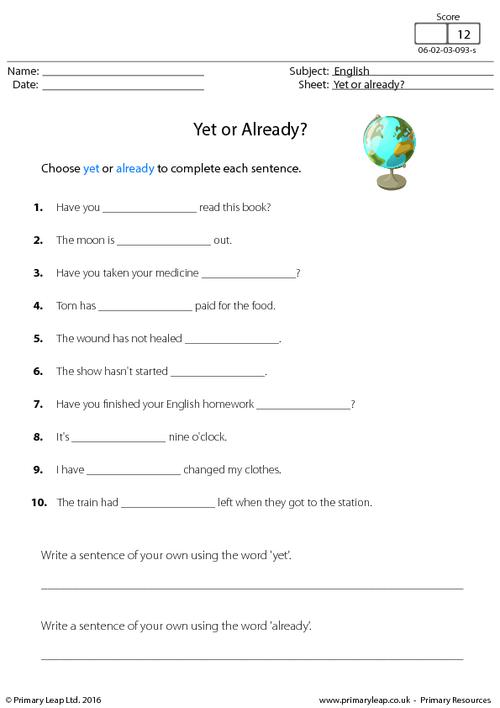
Yet or Already?

Yet or Already?

Yet or already? Students are asked to choose the correct word to complete each sentence.

Age: 10 - 11
1
2
3
Early or Soon?

Early or Soon?

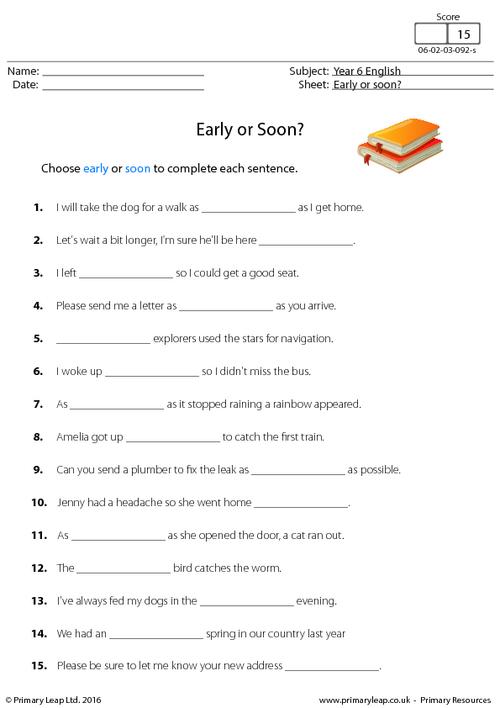
Early or soon? Students are asked to choose the correct word to complete each sentence.

Age: 10 - 11
1
2
3
Which Homonym? (4)

Which Homonym? (4)

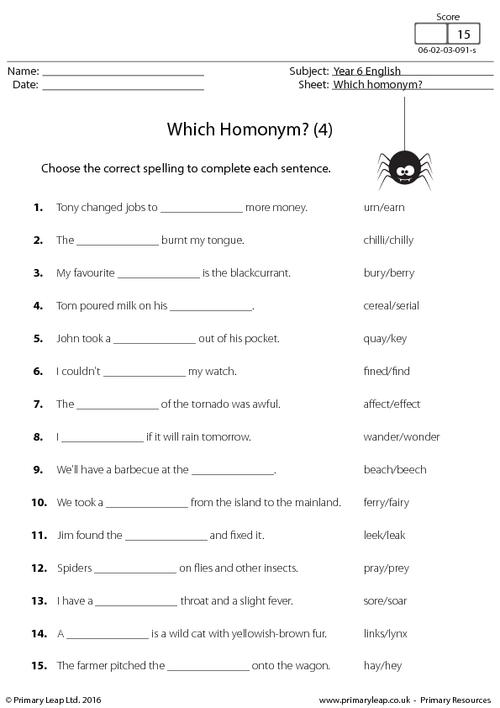
Homonyms are words that sound like one another but have different meanings. Students read the sentences and choose the correct spelling to complete each sentence. Some examples included on this worksheet are: urn/earn, quay/key, beach/beech, hay/hey.

Age: 10 - 11
1
2
3
Which Homonym? (3)

Which Homonym? (3)

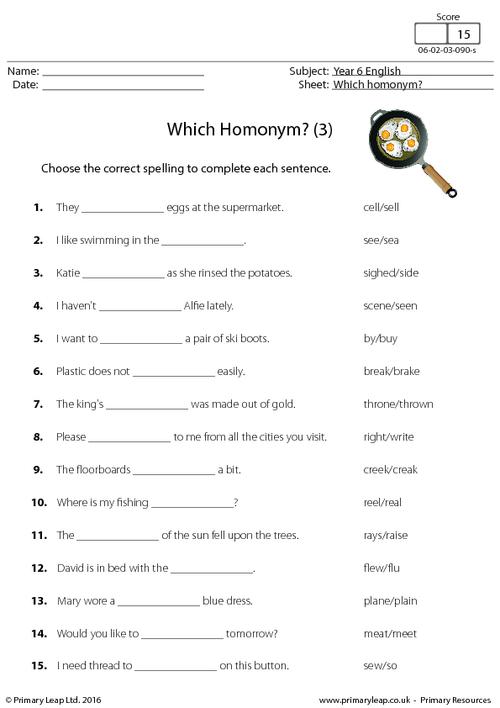
Homonyms are words that sound like one another but have different meanings. Students read the sentences and choose the correct spelling to complete each sentence.

Age: 10 - 11
1
2
3
Which Homonym? (2)

Which Homonym? (2)

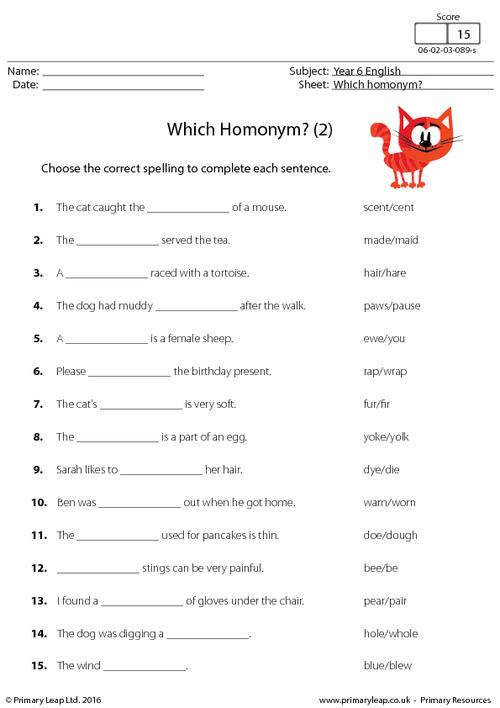
Homonyms are words that sound like one another but have different meanings. Students read the sentences and choose the correct spelling to complete each sentence.

Age: 10 - 11
1
2
3
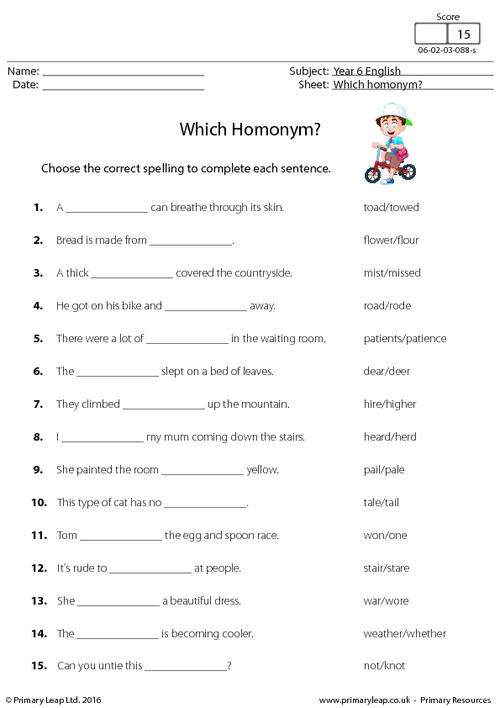
Which Homonym?

Which Homonym?

Homonyms are words that sound like one another but have different meanings. Students read the sentences and choose the correct spelling to complete each sentence.

Age: 10 - 11
1
2
3
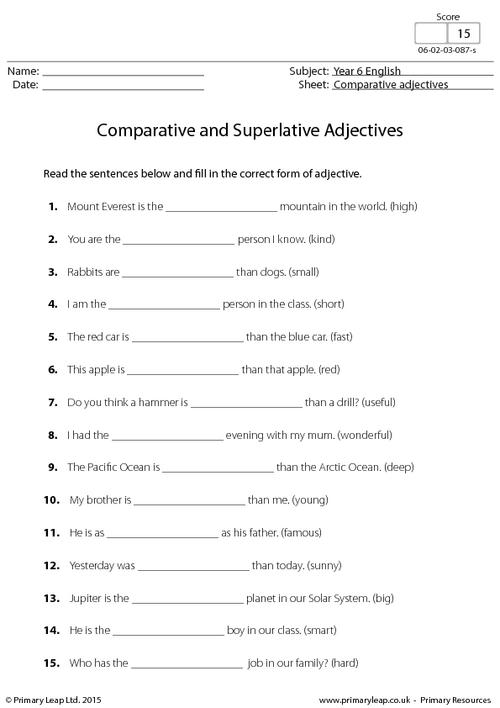
Comparative and Superlative Adjectives

Comparative and Superlative Adjectives

Students are asked to read the sentences and fill in the correct form of adjective.

Age: 10 - 11
1
2
3
Antonym Match (2)

Antonym Match (2)

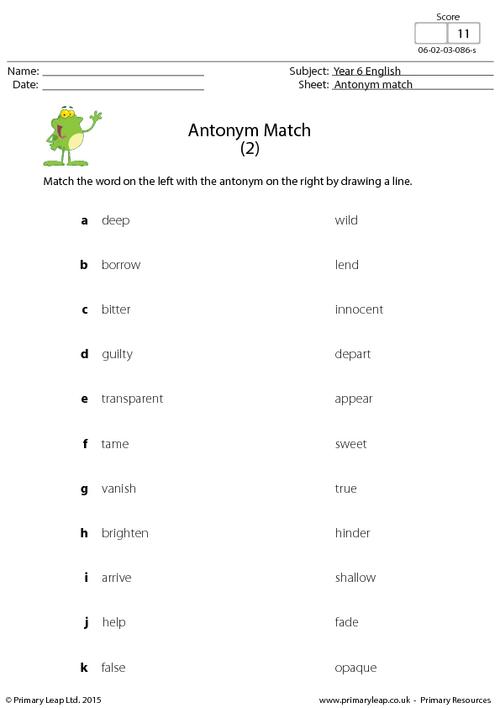
An antonym is a word opposite in meaning to another (e.g. bad and good ). Students are asked to match the word on the left with the antonym on the right by drawing a line.

Age: 10 - 11
1
2
3
Antonym Match (1)

Antonym Match (1)

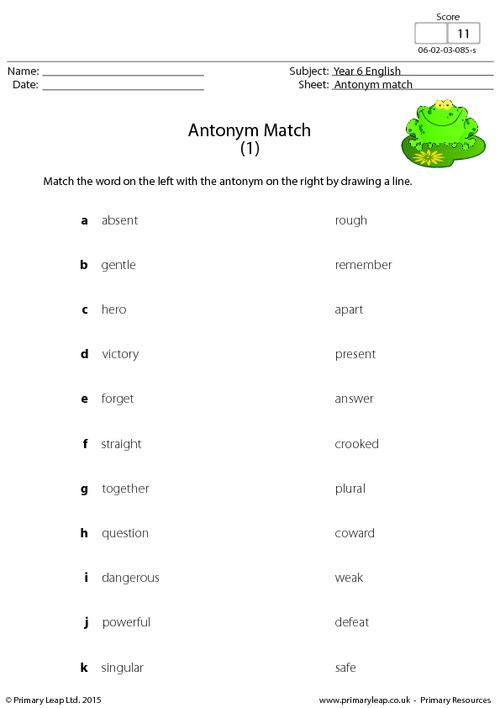
An antonym is a word opposite in meaning to another (e.g. bad and good ). Students are asked to match the word on the left with the antonym on the right by drawing a line.

Age: 10 - 11
1
2
3
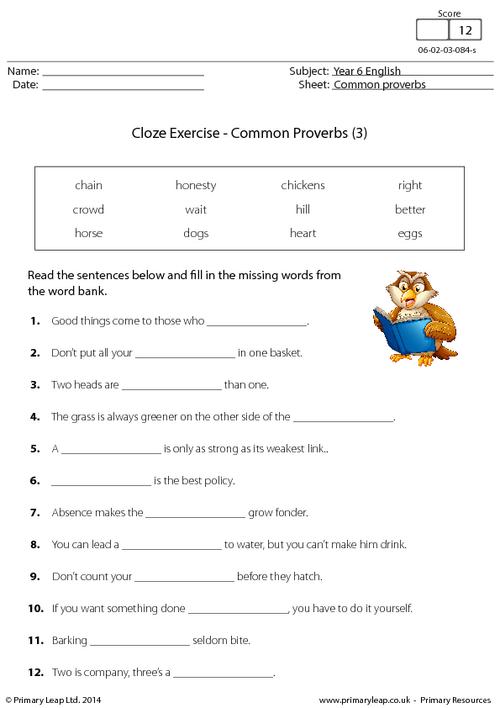
Cloze Exercise - Common Proverbs (3)

Cloze Exercise - Common Proverbs (3)

It's helpful to know the really common English proverbs because we hear them come up in conversation all the time. 'The early bird catches the worm', this saying is called a proverb. Students are asked to read the proverbs and fill in the missing words from the word bank. There are 12 sentences to complete.

Age: 10 - 11
1
2
3
Cloze Exercise - Common Proverbs (2)

Cloze Exercise - Common Proverbs (2)

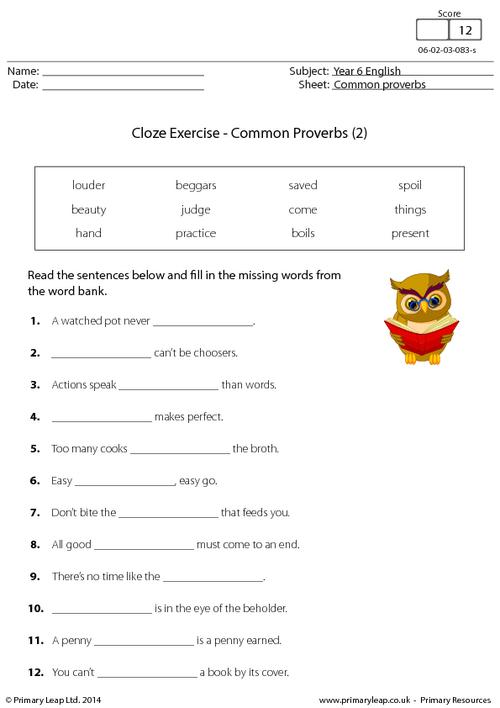
It's helpful to know the really common English proverbs because we hear them come up in conversation all the time. 'The early bird catches the worm', this saying is called a proverb. Students are asked to read the proverbs and fill in the missing words from the word bank. There are 12 sentences to complete.

Age: 10 - 11
1
2
3
Cloze Exercise - Common Proverbs (1)

Cloze Exercise - Common Proverbs (1)

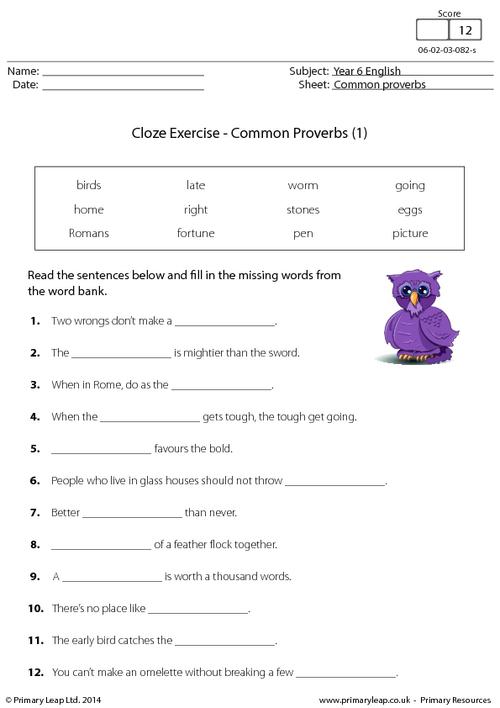
It's helpful to know the really common English proverbs because we hear them come up in conversation all the time. 'Two wrongs don't make a right', this saying is called a proverb. Students are asked to read the proverbs and fill in the missing words from the word bank. There are 12 sentences to complete.

Age: 10 - 11
1
2
3
Possessive or plural? (3)

Possessive or plural? (3)

Year 6 English - This resource is all about possessive and plural nouns. Students are asked to read the sentences and write the correct noun in the space provided. They then decide whether the noun is possessive or plural.

Age: 10 - 11
1
2
3
Possessive or plural? (2)

Possessive or plural? (2)

Year 6 English - This resource is all about possessive and plural nouns. Students are asked to read the sentences and write the correct noun in the space provided. They then decide whether the noun is possessive or plural.

Age: 10 - 11
1
2
3
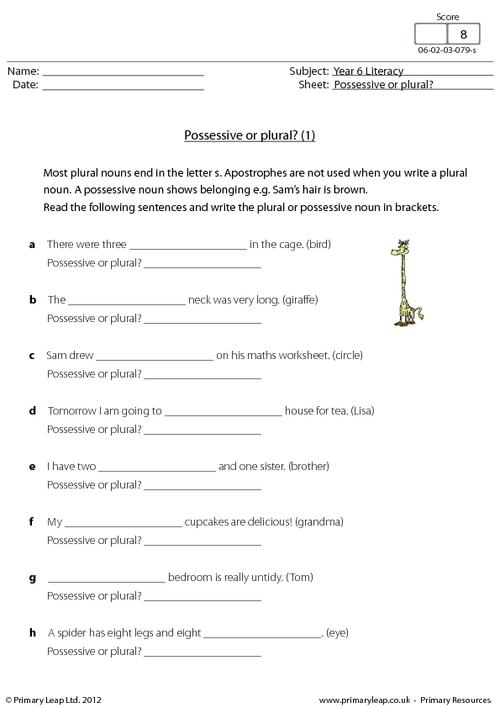
Possessive or plural? (1)

Possessive or plural? (1)

Year 6 English - This resource is all about possessive and plural nouns. Students are asked to read the sentences and write the correct noun in the space provided. They then decide whether the noun is possessive or plural.

Age: 10 - 11
1
2
3
Identifying adjectives, verbs and nouns

Identifying adjectives, verbs and nouns

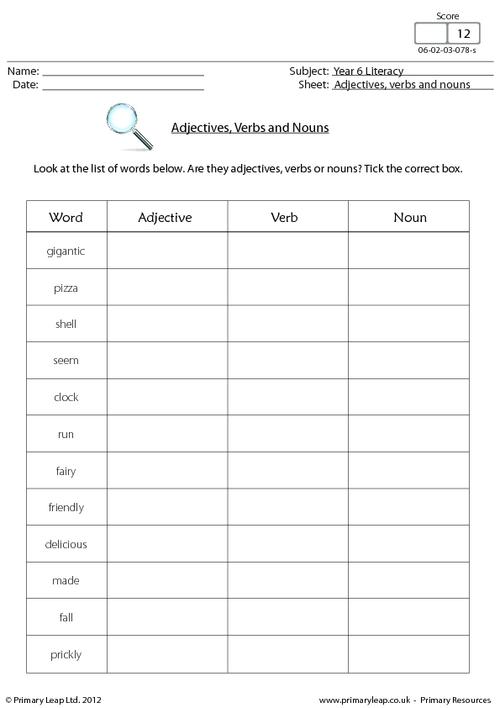
Look at the list of words below. Are they adjectives, verbs or nouns? Tick the correct box.

Age: 10 - 11
1
2
3
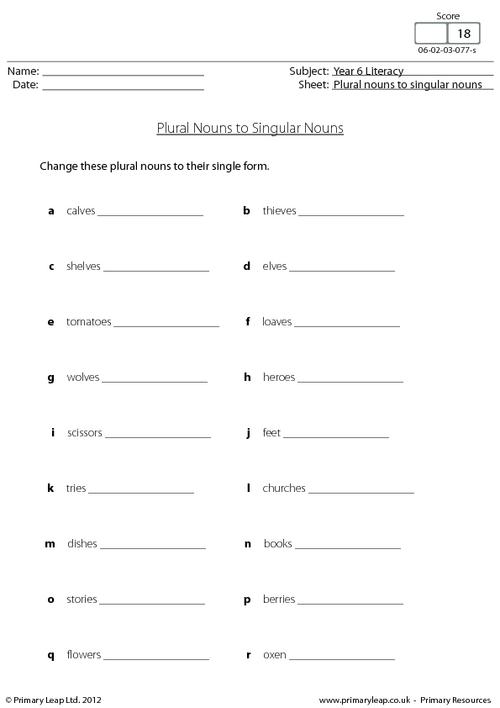
Changing plural nouns to singular nouns

Changing plural nouns to singular nouns

Change these plural nouns to their singular form.

Age: 10 - 11
1
2
3
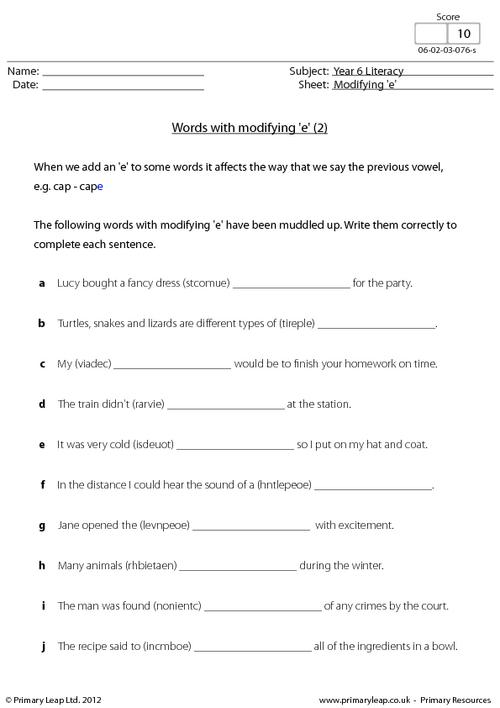
Words with modifying 'e' 2

Words with modifying 'e' 2

Words with magic 'e' affect the way we say the previous vowel. Students write the magic e words correctly.

Age: 10 - 11
1
2
3
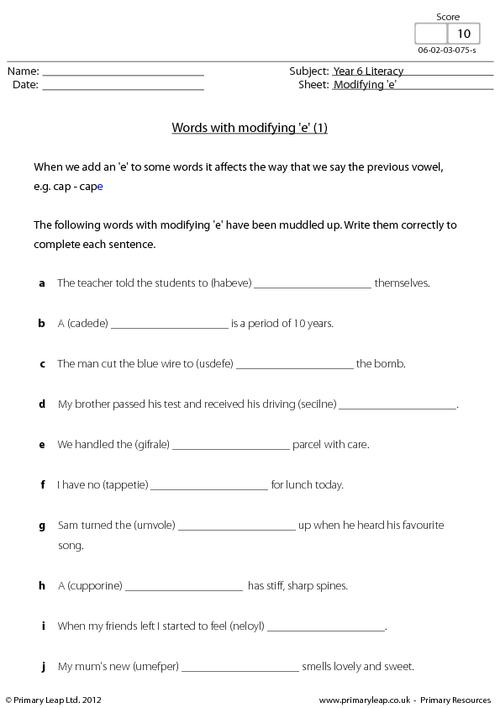
Words with modifying 'e' 1

Words with modifying 'e' 1

Words with magic 'e' affect the way we say the previous vowel. Students write the magic e words correctly.

Age: 10 - 11
1
2
3
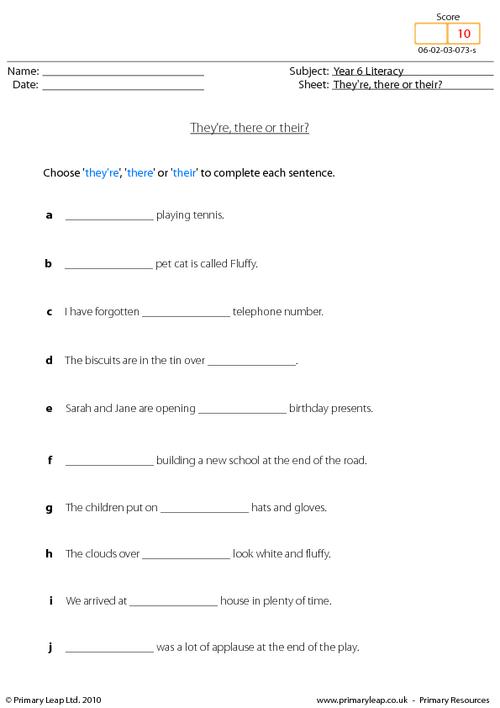
They're, there or their? (4)

They're, there or their? (4)

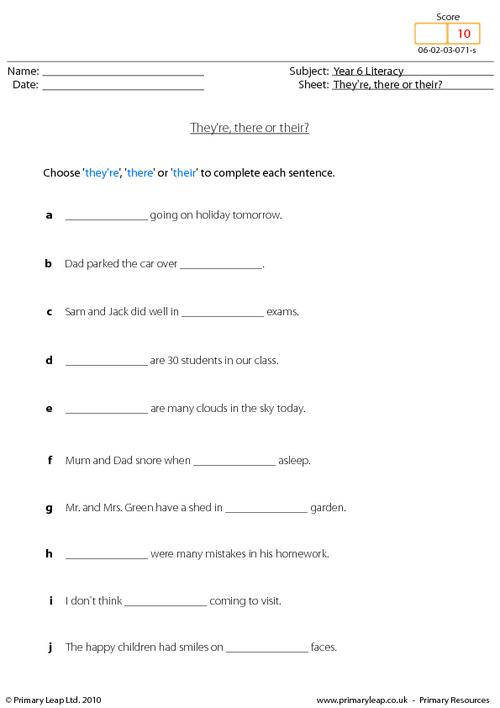
Students choose they're, there or their to complete the sentences.

Age: 10 - 11
1
2
3
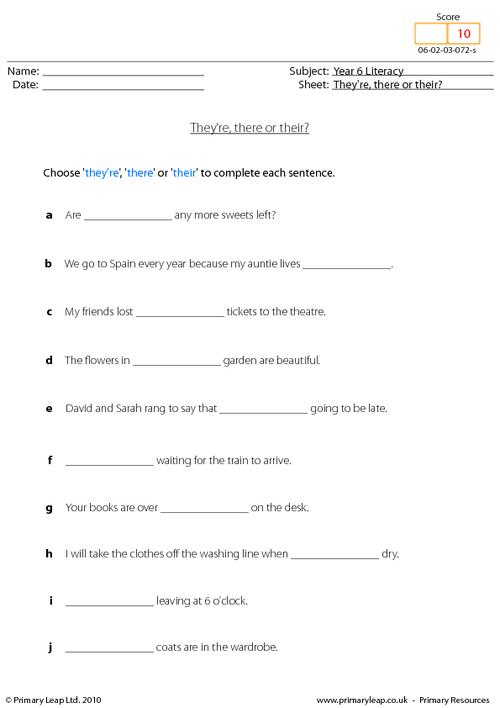
They're, there or their? (3)

They're, there or their? (3)

Students choose they're, there or their to complete the sentences.

Age: 10 - 11
1
2
3
They're, there or their? (2)

They're, there or their? (2)

Students choose they're, there or their to complete the sentences.

Age: 10 - 11
1
2
3
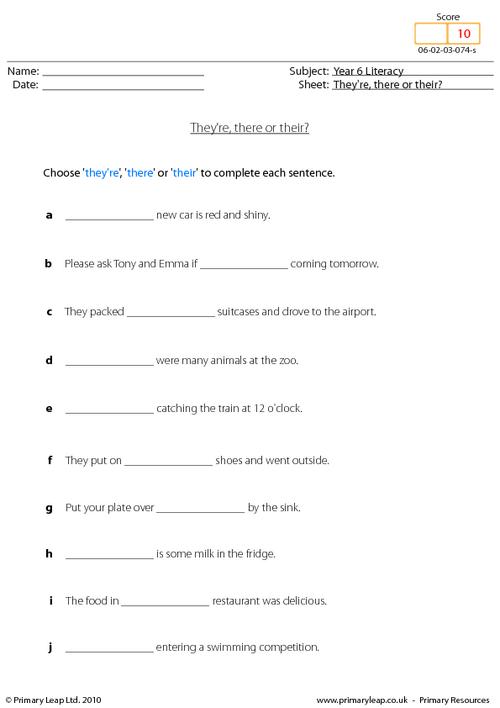
They're, there or their? (1)

They're, there or their? (1)

Students choose they're, there or their to complete the sentences.

Age: 10 - 11
1
2
3
Similar meanings 9

Similar meanings 9

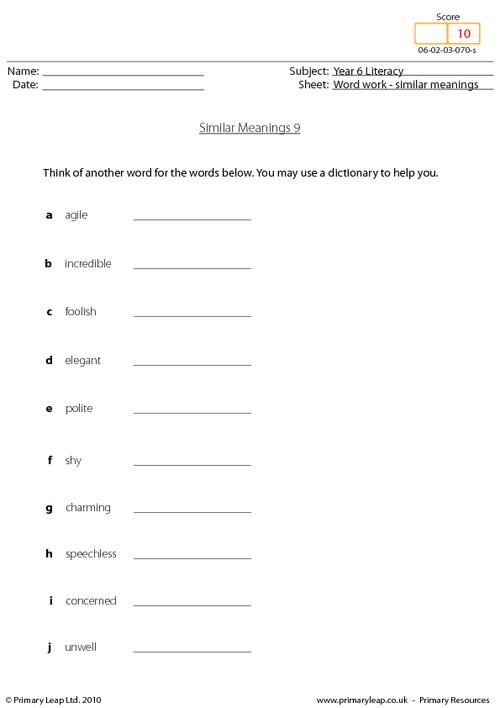
Many words have similar meanings e.g. big and large. Students must look at the words and think of another word which has a similar meaning.

Age: 10 - 11
1
2
3
Similar meanings 8

Similar meanings 8

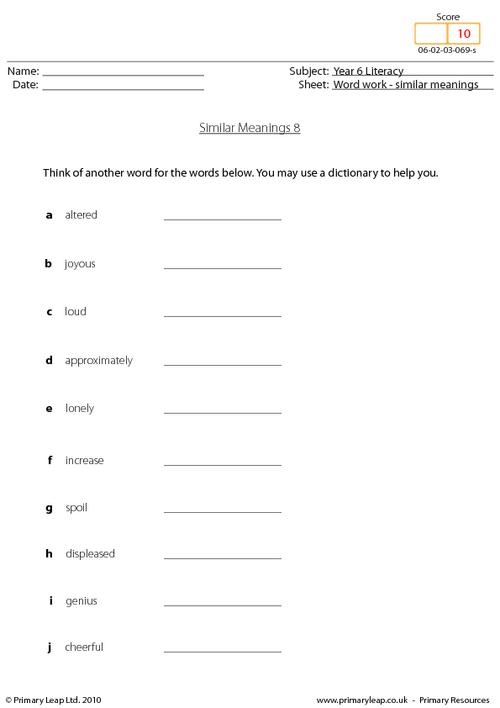
Many words have similar meanings e.g. big and large. Students must look at the words and think of another word which has a similar meaning.

Age: 10 - 11
1
2
3
Similar meanings 7

Similar meanings 7

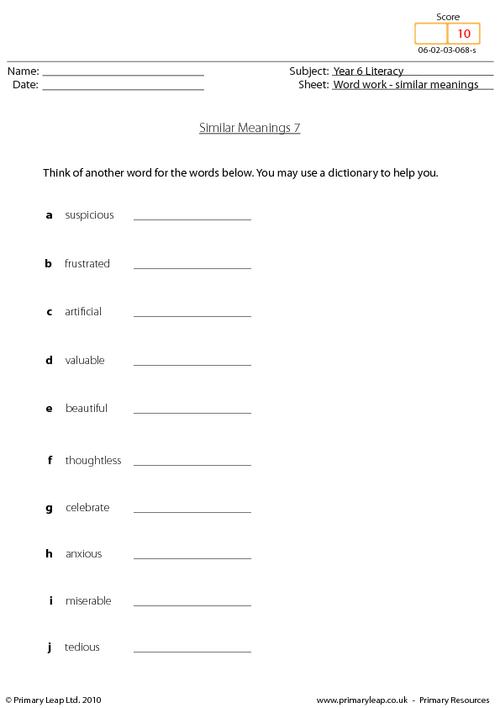
Many words have similar meanings e.g. big and large. Students must look at the words and think of another word which has a similar meaning.

Age: 10 - 11
1
2
3
Similar meanings 6

Similar meanings 6

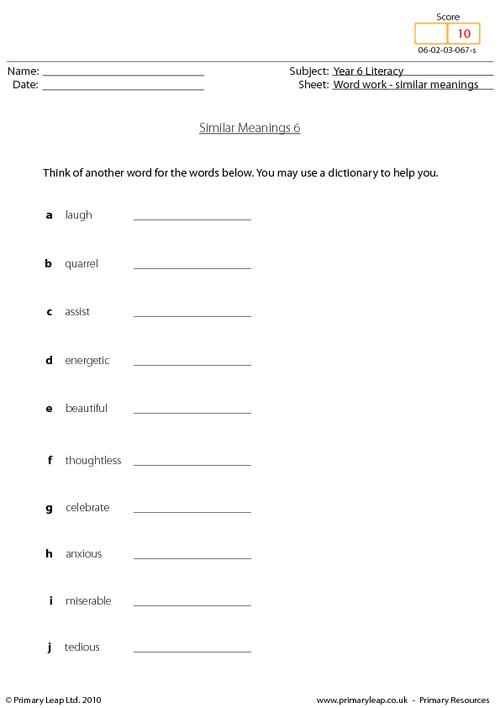
Many words have similar meanings e.g. big and large. Students must look at the words and think of another word which has a similar meaning.

Age: 10 - 11
1
2
3
Similar meanings 5

Similar meanings 5

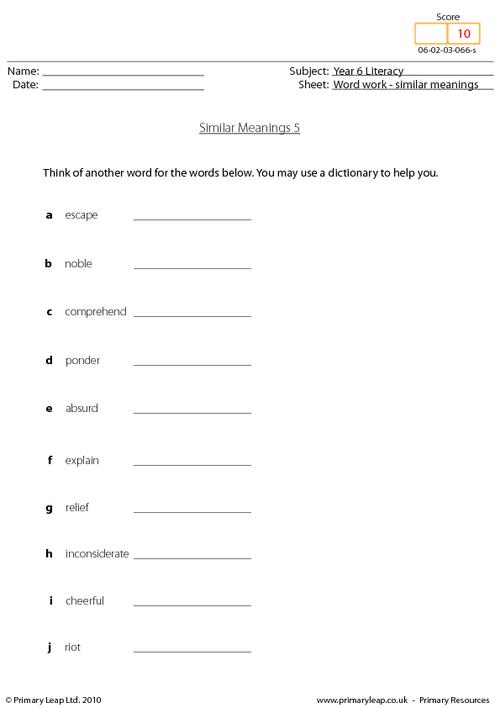
Many words have similar meanings e.g. big and large. Students must look at the words and think of another word which has a similar meaning.

Age: 10 - 11
1
2
3
Similar meanings 4

Similar meanings 4

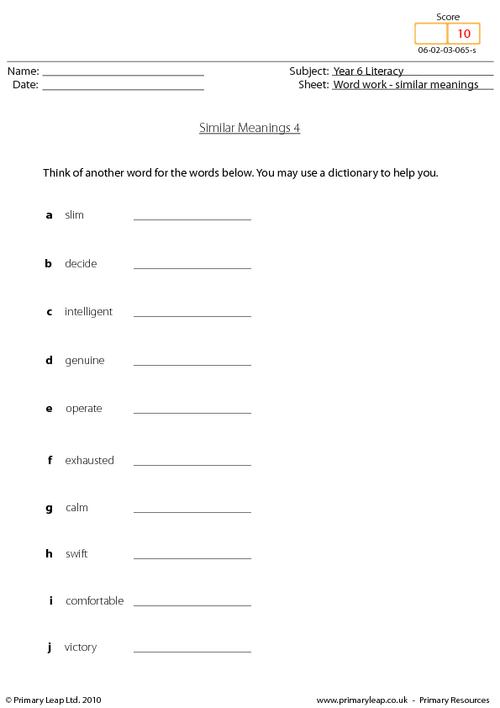
Many words have similar meanings e.g. big and large. Students must look at the words and think of another word which has a similar meaning.

Age: 10 - 11
1
2
3
Similar meanings 3

Similar meanings 3

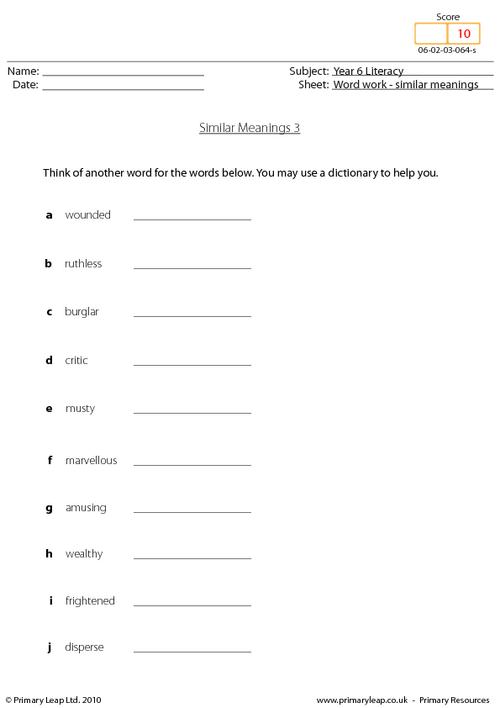
Many words have similar meanings e.g. big and large. Students must look at the words and think of another word which has a similar meaning.

Age: 10 - 11
1
2
3
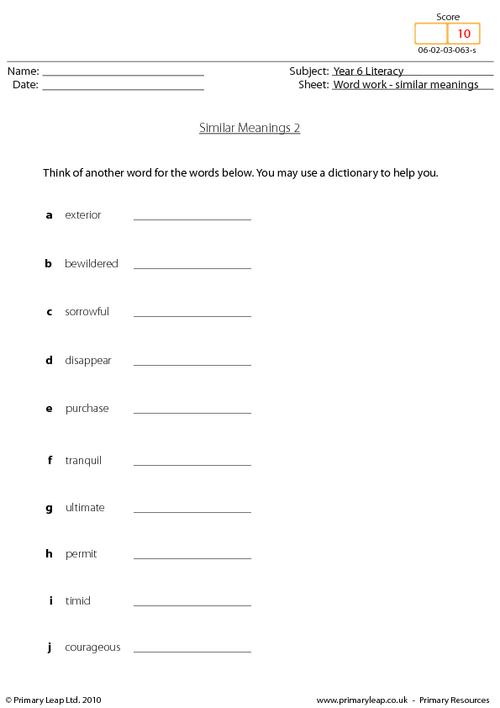
Similar meanings 2

Similar meanings 2

Many words have similar meanings e.g. big and large. Students must look at the words and think of another word which has a similar meaning.

Age: 10 - 11
1
2
3
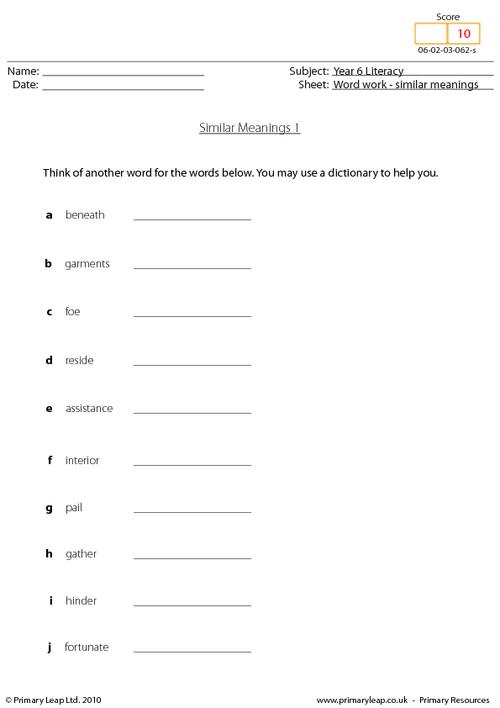
Similar meanings 1

Similar meanings 1

Many words have similar meanings e.g. big and large. Students must look at the words and think of another word which has a similar meaning.

Age: 10 - 11
1
2
3
5 syllable challenge

5 syllable challenge

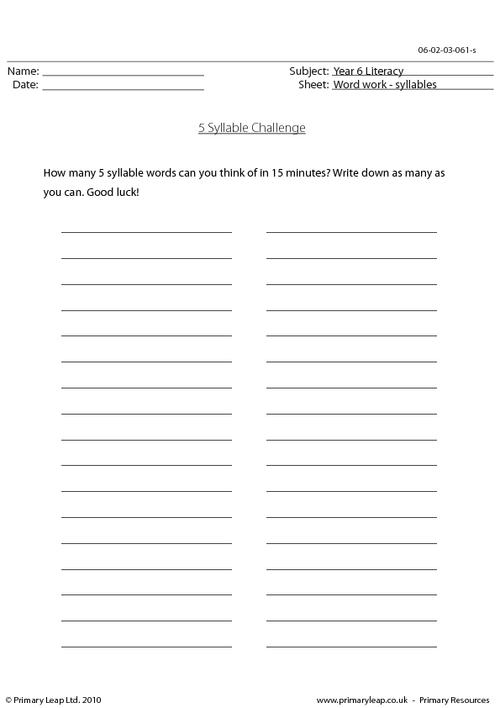
A syllable is any one of the parts into which a word is divided when it is pronounced e.g. el-e-phant = 3 syllables. Students think of as many 5 syllable words as they can. Why not have a competition with a friend?

Age: 10 - 11
1
2
3
4 syllable challenge

4 syllable challenge

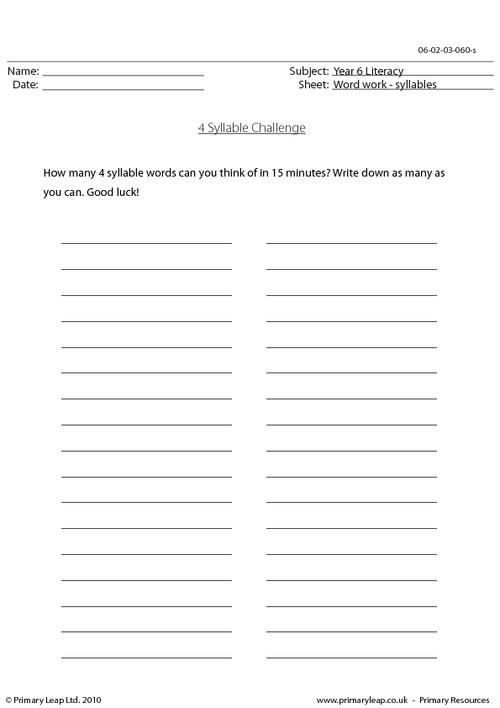
A syllable is any one of the parts into which a word is divided when it is pronounced e.g. el-e-phant = 3 syllables. Students think of as many 4 syllable words as they can. Why not have a competition with a friend?

Age: 10 - 11
1
2
3
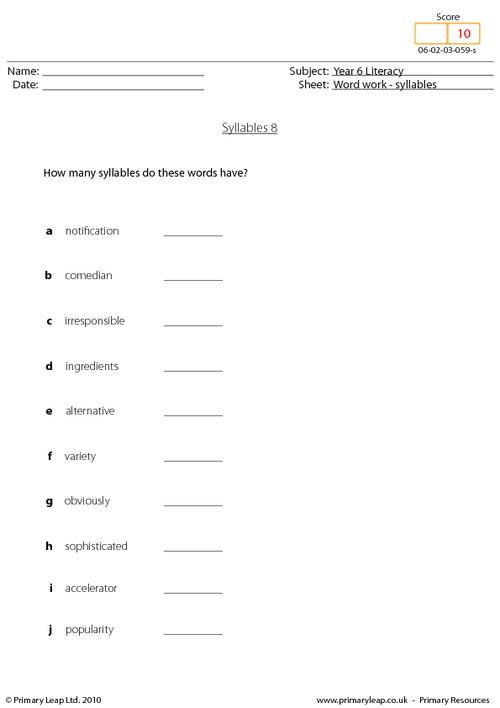
Syllables 8

Syllables 8

A syllable is any one of the parts into which a word is divided when it is pronounced e.g. el-e-phant = 3 syllables. Students read the words and write how many syllables each word has.

Age: 10 - 11
1
2
3
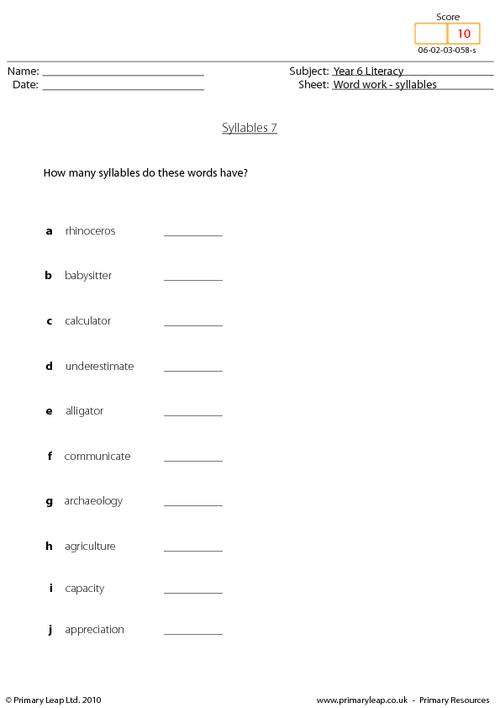
Syllables 7

Syllables 7

A syllable is any one of the parts into which a word is divided when it is pronounced e.g. el-e-phant = 3 syllables. Students read the words and write how many syllables each word has.

Age: 10 - 11
1
2
3
Syllables 6

Syllables 6

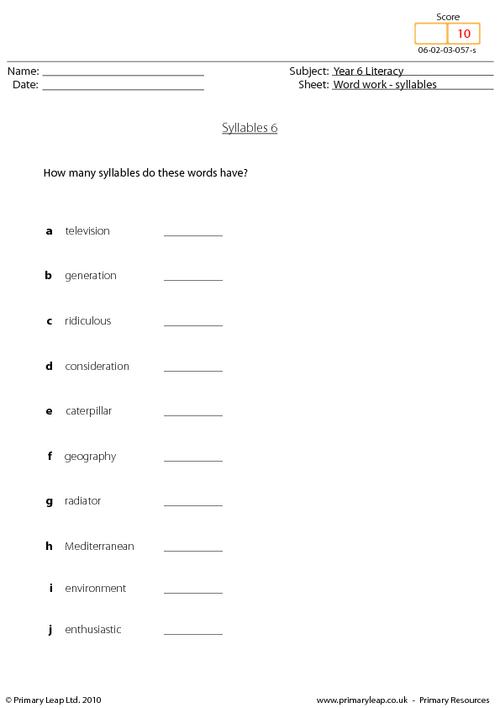
A syllable is any one of the parts into which a word is divided when it is pronounced e.g. el-e-phant = 3 syllables. Students read the words and write how many syllables each word has.

Age: 10 - 11
1
2
3
Syllables 5

Syllables 5

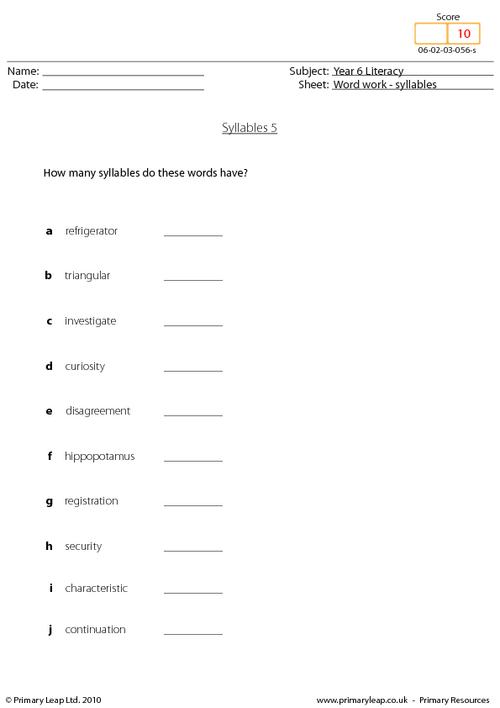
A syllable is any one of the parts into which a word is divided when it is pronounced e.g. el-e-phant = 3 syllables. Students read the words and write how many syllables each word has.

Age: 10 - 11
1
2
3
of 2

Year 6 English Word Work Worksheets - Created by teachers and loved by kids

Check out our ready-to-use Year 6 English Word Work worksheets that can be used in the classroom or at home. Simply download or print and watch your child’s confidence grow with our easy to follow Year 6 English Word Work printables.

Learn

One of the best things about printable worksheets is that they make learning fun and easy. Explore our educational resources based on Year 6 English Word Work and keep your children learning through these fun and engaging exercises.

Progress

Our Year 6 English Word Work printable worksheets are designed for progressive learning. Our engaging content enables a child to learn at their own speed and gain confidence quickly. When we help a child believe in themselves, we empower them for life.

Improve

Printable worksheets are a great way to enhance creativity and improve a child’s knowledge. Help your child learn more about Year 6 English Word Work with this great selection of worksheets designed to help children succeed.

We use cookies to improve your experience on our site and to show you personalized advertising.

To find out more, read our privacy policy and cookie policy.

Okay! No, thanks.